
 NAVISH NOOR· Aug 8, 2026
Voice is one of the most important parts of a video advertisement.
A strong voiceover can make an advertisement feel professional, memorable, and persuasive. Traditionally, brands have relied on professional voice actors, studio recordings, and multiple recording sessions to produce different versions of an ad.
AI voice cloning is changing that workflow.
Modern AI voice technology can create synthetic speech based on a voice sample, allowing brands to generate new narration from written scripts. When used responsibly and with proper permission, this can make video production significantly more flexible.
For brands investing in AI video advertising services, voice cloning can become an important part of a larger AI-powered production workflow.
What Is AI Voice Cloning?
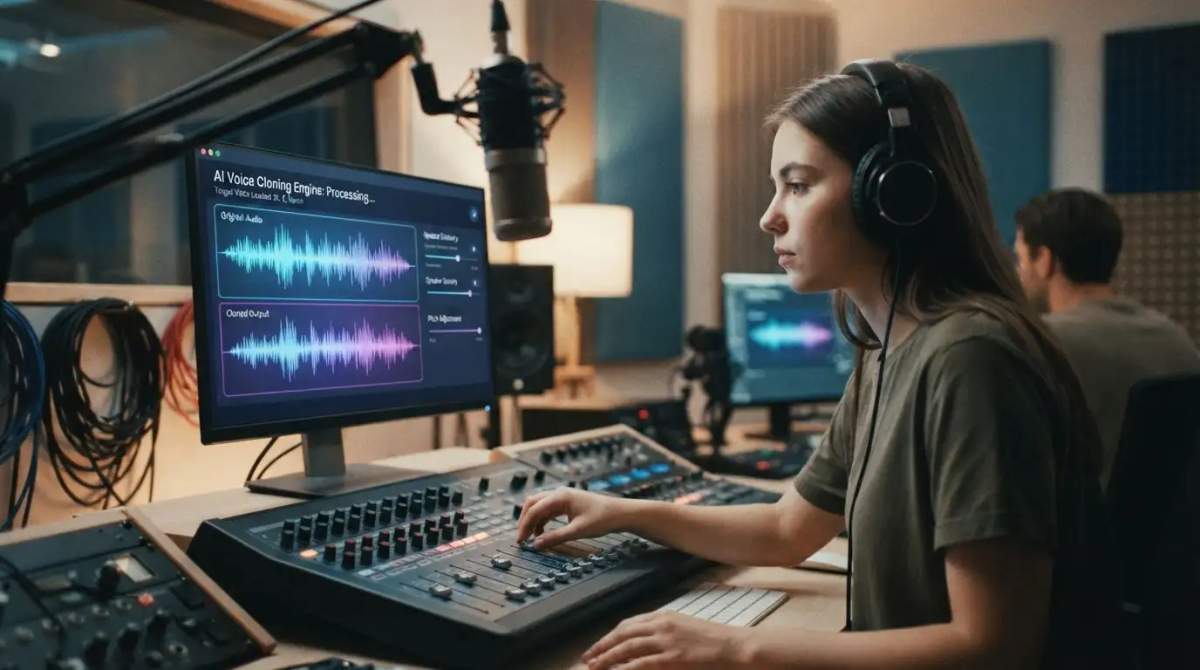
AI voice cloning uses artificial intelligence to analyze characteristics of a person's voice and generate new speech that resembles that voice.
Instead of recording every sentence manually, an approved voice model can be used to produce new narration from a script.
This can be useful when a brand needs frequent content updates.
For example, a company may create a product advertisement and later need to update the price, product feature, or call-to-action.
With traditional production, another recording may be required.
With an appropriate AI voice workflow, the updated section can potentially be generated without bringing the voice actor back into a studio.
Why Brands Are Using AI Voice Technology
Faster production
Voice recording can become a bottleneck when campaigns require multiple versions.
AI can help accelerate the process by generating narration after the script is approved.
This is particularly useful for social media campaigns where brands may need several variations of the same advertisement.
Easier revisions
Advertising campaigns frequently change.
A product feature might be updated. A promotion may expire. A company may change its call-to-action.
AI voice generation can make these revisions much easier to manage.
Multiple languages
Global campaigns often require localized voiceovers.
AI voice technology can assist with creating versions of the same content for different markets, although professional translation and human review remain important.
A direct word-for-word translation isn't always enough.
The message should sound natural in the target language and fit the cultural context of the audience.
More creative variations
Modern advertising increasingly relies on testing.
A brand may want several versions of an advertisement with different hooks or messaging.
AI voice generation can make producing those variations more efficient.
AI Voice Cloning and Traditional Voice Actors
AI voice cloning doesn't eliminate the value of professional voice actors.
Human performers bring emotion, interpretation, personality, and creative nuance to a script.
For major campaigns, brands may still prefer a professional actor to deliver the original performance.
AI can then potentially be used for approved variations and updates, depending on the agreement with the performer.
This creates a hybrid model.
A voice actor provides the original performance and grants appropriate rights for AI-assisted use, while the technology helps the brand scale the voice across additional content.
Consent and Voice Rights Matter
Voice cloning requires responsible use.
A brand should never clone someone's voice without appropriate permission.
A person's voice can be closely connected to their identity and professional reputation. Using a recognizable voice without authorization can create legal, ethical, and trust issues.
Before using an AI voice clone commercially, brands should establish clear agreements covering:
- Who owns or controls the voice model
- Where the voice can be used
- How long it can be used
- Which advertising channels are permitted
- Whether the voice can be used in other languages
- How the model can be modified or reused
- What happens when the agreement ends
These considerations are particularly important for commercial advertising.
AI Voice Cloning for Video Ads
Video advertising is one of the strongest applications for AI voice technology because advertisements frequently require variations.
Consider a campaign for a new product.
The brand might create:
Version 1: A 30-second YouTube advertisement.
Version 2: A 15-second social media advertisement.
Version 3: A short TikTok version.
Version 4: A product-focused variation.
Version 5: A localized version for another market.
Instead of recording each version separately, an AI-assisted workflow can help generate the required narration from approved scripts.
The visual content can then be edited around each version.
Why Voice Quality Still Matters
One of the biggest mistakes brands can make is assuming that generating a voice is enough.
A technically accurate voice can still sound wrong for an advertisement.
Good commercial narration requires attention to:
- Pacing
- Pronunciation
- Emphasis
- Tone
- Pauses
- Emotion
- Brand personality
A luxury brand might require a calm and sophisticated delivery.
A sports brand may need energy and urgency.
A healthcare company may need a reassuring and professional tone.
The voice should therefore be treated as part of the creative direction.
Combining AI Voice With AI Video
The real potential appears when voice technology is combined with other AI production tools.
A modern workflow can potentially combine:
- AI voice generation
- AI avatars
- AI animation
- AI-generated visuals
- Motion graphics
- Captions
- Automated editing
- Traditional video footage
This creates a broader AI video production service rather than a simple voice-generation process.
The voice becomes one component of the final creative.
AI Voice Can Improve Content Repurposing
One advertisement can often become multiple pieces of content.
A long product video can be turned into short clips, social media advertisements, educational videos, and promotional content.
AI voice technology can make it easier to adapt the narration for these different formats.
For example, a 60-second advertisement could be converted into three 20-second versions, each focused on a different benefit.
This can help brands produce more content from the same campaign idea.
Where AI Voice Cloning Works Best
AI voice technology can be especially useful for:
- Product advertisements
- Social media videos
- Explainer videos
- Corporate communications
- Training content
- Tutorials
- E-learning
- Product demonstrations
- Multilingual campaigns
- Frequently updated advertisements
It can be particularly valuable for companies producing content at high volume.
Where Human Voice Performance May Be Better
There are also situations where a human performance can provide greater value.
For example:
- Emotional brand films
- Personal founder messages
- Major television campaigns
- Documentary storytelling
- Character-driven advertisements
- High-profile celebrity campaigns
If the emotional performance is the central element of the campaign, a real voice actor or spokesperson may be the better choice.
AI should be selected based on the creative objective—not simply because it is available.
How Brands Should Use AI Voice Responsibly
A responsible workflow should begin with permission.
If a brand wants to clone a person's voice, that person should understand how the voice will be used and agree to the relevant commercial applications.
Brands should also consider transparency.
If audiences could reasonably believe that a real person recorded a new statement when they did not, appropriate disclosure may be necessary depending on the context and applicable rules.
Responsible AI use protects both the brand and the people whose voices are involved.
The Future of AI Voice in Advertising
Voice cloning is likely to become increasingly integrated into video production.
Instead of treating voiceover as a separate production stage, brands may build voice generation directly into their content systems.
A single campaign could then be adapted for:
- Different audiences
- Different platforms
- Different languages
- Different offers
- Different video lengths
This creates a more flexible advertising workflow.
However, the technology will only be as effective as the creative strategy behind it.
A perfect voice cannot fix a weak advertisement.
The script, concept, visuals, targeting, offer, and call-to-action still determine whether the campaign succeeds.
How ContentMesh Can Use AI Voice Technology
At ContentMesh, AI voice technology can be integrated into a broader video production workflow.
Instead of treating voice generation as an isolated tool, it can be combined with scripting, AI avatars, animation, visual storytelling, editing, captions, and platform-specific formats.
This allows brands to develop advertising content that can be adapted and scaled without rebuilding every production from the beginning.
The goal is not simply to make an artificial voice sound human.
The goal is to use technology to create better, faster, and more adaptable video content.
Final Thoughts
AI voice cloning is changing how brands approach video advertising.
It can reduce production friction, simplify revisions, support localization, and make creative testing easier.
But responsible implementation matters.
Brands need appropriate permission, clear voice rights, human quality control, and a strong creative strategy.
Used correctly, AI voice technology can become a powerful part of modern AI video advertising services—helping brands produce more variations while maintaining a consistent voice and identity.
The future of advertising won't necessarily be entirely human or entirely AI.
It will increasingly be a combination of both.
Ready to Scale Your Brand with Custom AI Video Production?
Let ContentMesh build high-performing AI video ads, product showcases, animations, or custom avatars for your brand.