
 NAVISH NOOR· Aug 2, 2026
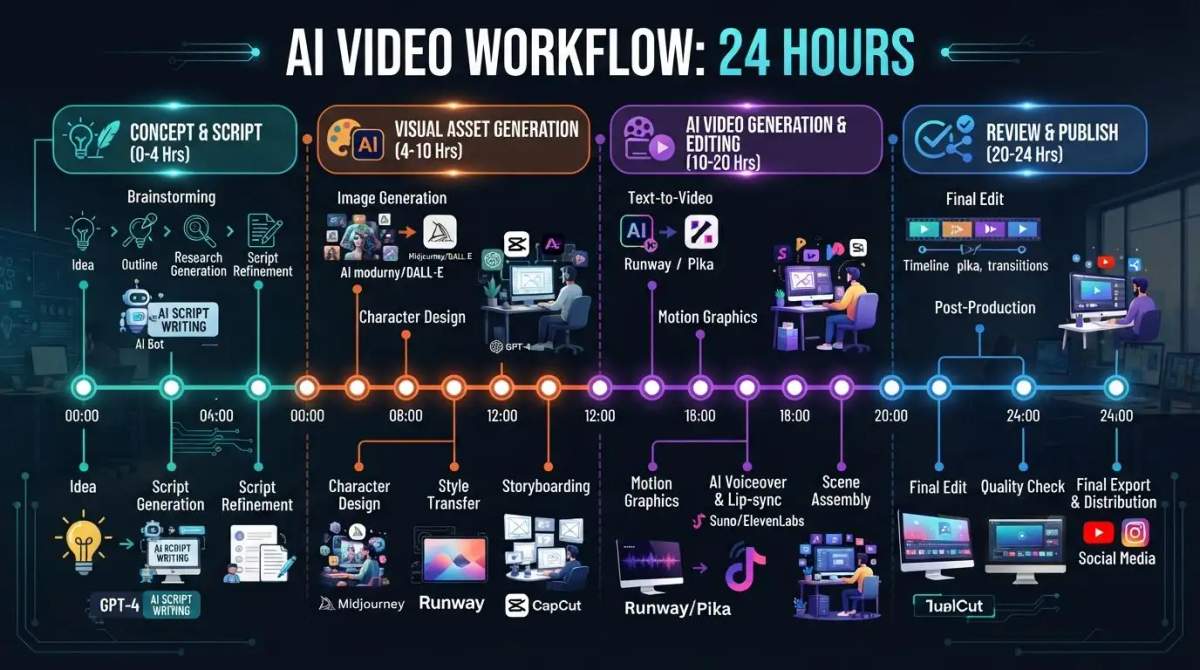
Traditional video production can take weeks. A project may involve script development, casting, location planning, filming, editing, revisions, and final delivery before the finished video reaches the audience.
For brands that need to move quickly, that timeline can become a problem.
Modern AI video production offers a different approach.
With the right workflow, businesses can move from an approved script to a finished video much faster. AI can assist with presenters, voiceovers, visuals, animation, editing, and content variations, while human creative direction ensures the final result remains aligned with the brand.
At ContentMesh, the goal isn't simply to make videos faster. It's to create a production workflow that allows brands to turn ideas into high-quality content without unnecessary delays.
Here's what that process can look like.
Step 1: Start With the Brief
Every successful video begins with a clear objective.
Before production begins, the creative team needs to understand what the video is supposed to achieve.
Is it designed to:
- Generate leads?
- Explain a product?
- Introduce a service?
- Increase awareness?
- Educate customers?
- Promote an offer?
- Build trust?
- Generate social media engagement?
The audience also matters.
A product video aimed at software developers will have a very different tone from an advertisement aimed at consumers.
This initial brief provides the foundation for the entire production.
Step 2: Develop and Approve the Script
The script is the backbone of the video.
AI tools can help generate ideas, outlines, hooks, and alternative versions, but the final script should be reviewed and refined by humans.
A strong video script should communicate the main idea quickly.
For short-form content, the opening seconds are particularly important.
The script should establish a problem, create curiosity, or communicate a clear benefit before the viewer loses interest.
Once the script is approved, production can move forward.
This is important because unnecessary script changes later in the process can affect visuals, voiceover, timing, and editing.
Step 3: Choose the Visual Direction
Next comes the visual concept.
Depending on the project, this could involve:
- AI avatars
- Product footage
- Motion graphics
- AI-generated scenes
- Animation
- Stock footage
- Screen recordings
- Typography
- Brand graphics
The visual direction should match the brand.
A financial company may need a professional and trustworthy aesthetic. A gaming brand may require something energetic and highly stylized.
AI makes it possible to explore multiple creative directions quickly before selecting the final approach.
Step 4: Generate the Voice or Presenter
If the video requires a presenter, an AI avatar video service can provide a digital spokesperson.
Alternatively, AI voice technology can be used for narration.
This can be particularly useful for brands that need multiple videos, because the same presenter and voice can be maintained across an entire content series.
For example, a company could create a consistent digital presenter for:
- Product tutorials
- Customer onboarding
- Social media videos
- Advertisements
- Educational content
- Frequently asked questions
Consistency helps make separate videos feel like part of the same brand.
Step 5: Build the Visuals
The next stage is where the script becomes a visual story.
AI can help generate or assemble visual elements based on the approved concept.
For example, if the script discusses a software platform, the video might combine an AI presenter with screen recordings and animated interface elements.
If the video is explaining a scientific concept, animation and motion graphics may be more appropriate.
The objective isn't to fill every second with AI-generated imagery.
The objective is to choose visuals that help the audience understand and remember the message.
Step 6: Edit the Video
Editing brings all the individual elements together.
The editor can combine:
- Presenter footage
- Voiceover
- Animation
- B-roll
- Motion graphics
- Captions
- Music
- Sound effects
- Brand elements
This is where pacing becomes especially important.
Even a strong script can become boring if every shot remains on screen for too long.
Professional editing creates rhythm and keeps visual changes connected to the story.
Step 7: Add Branding
A video should feel like it belongs to the company that published it.
Brand elements can include:
- Logo
- Typography
- Colors
- Lower thirds
- Graphics
- Intro and outro
- Product imagery
- Call-to-action
Creating reusable brand templates can make future production significantly faster.
Instead of rebuilding the visual identity for every project, the team can use an established system.
This is one reason AI-powered video production becomes more valuable when used as an ongoing content strategy rather than for one isolated video.
Step 8: Create Platform-Specific Versions
A finished video may need to appear on multiple platforms.
For example:
YouTube: 16:9
Instagram Reels: 9:16
TikTok: 9:16
LinkedIn: 1:1 or 16:9
Website: Depending on the page design
Instead of simply cropping the same video, the content can be adapted to the platform.
Captions, text placement, pacing, and framing may need to change.
This allows one production concept to generate multiple useful assets.
Step 9: Quality Control
Speed should never mean skipping quality control.
Before delivery, the video should be checked for:
- Spelling mistakes
- Incorrect information
- Voice pronunciation
- Audio levels
- Visual errors
- Brand consistency
- Caption accuracy
- Timing
- Aspect ratio
- Call-to-action
- Overall quality
Human review is especially important when AI tools are involved.
AI can accelerate production, but a final creative and factual review helps ensure the video is ready for publication.
Step 10: Deliver the Final Video
Once approved, the final assets can be delivered in the formats required by the client.
A single project might include a master video along with multiple short-form versions.
This means the client doesn't simply receive one video.
They can receive a collection of assets designed for their broader content strategy.
Can a Professional Video Really Be Made in 24 Hours?
The answer depends on the project.
A straightforward social media video, explainer, AI avatar video, or promotional piece can potentially move through the workflow very quickly when the script, branding, and creative direction are already clear.
A complex commercial involving extensive animation, custom visual effects, detailed storytelling, or significant revisions may require more time.
The important advantage of AI video production isn't promising that every project takes exactly 24 hours.
It is reducing unnecessary production friction.
The faster a team can move from idea to approved concept to production, the more content it can realistically create.
Why Speed Matters for Modern Brands
Marketing opportunities don't always wait for a traditional production schedule.
A company may launch a product next week.
A trend may become popular today.
A marketing campaign may need five new variations tomorrow.
Traditional production can struggle with these timelines.
An efficient AI video production service can help brands respond faster.
This is especially useful for social media teams, advertising departments, startups, SaaS companies, and businesses that regularly test different creative concepts.
AI + Human Creativity
The biggest misconception about AI video production is that it removes the need for creative professionals.
In reality, the strongest workflow combines both.
AI can help with speed and scalability.
Humans provide:
- Strategy
- Storytelling
- Creative judgment
- Brand understanding
- Editing decisions
- Quality control
The technology provides powerful production capabilities.
The creative team decides how those capabilities should be used.
The ContentMesh Approach
At ContentMesh, AI is treated as part of a broader production system.
The process begins with the client's objective and audience before moving into scripting, visual direction, production, editing, and quality control.
The goal is to make video production more efficient without sacrificing the creative thinking behind the content.
For brands that need regular marketing videos, social media content, advertisements, explainers, corporate videos, or AI avatar content, this workflow can provide a scalable alternative to producing every project through a traditional film crew.
From the first line of a script to the final frame, AI can help shorten the journey.
But the goal isn't simply faster video.
It's better content, produced efficiently, and ready when the brand needs it.
Ready to Scale Your Brand with Custom AI Video Production?
Let ContentMesh build high-performing AI video ads, product showcases, animations, or custom avatars for your brand.