
 NAVISH NOOR· Aug 7, 2026
Video has become one of the most important tools for modern marketing. Brands use video for advertisements, social media, product demonstrations, corporate communications, training, websites, and more.
But producing professional video can be expensive.
Traditional production often requires a film crew, camera equipment, lighting, audio, locations, actors, directors, editors, and multiple days of planning. For a single high-end campaign, these costs can quickly add up.
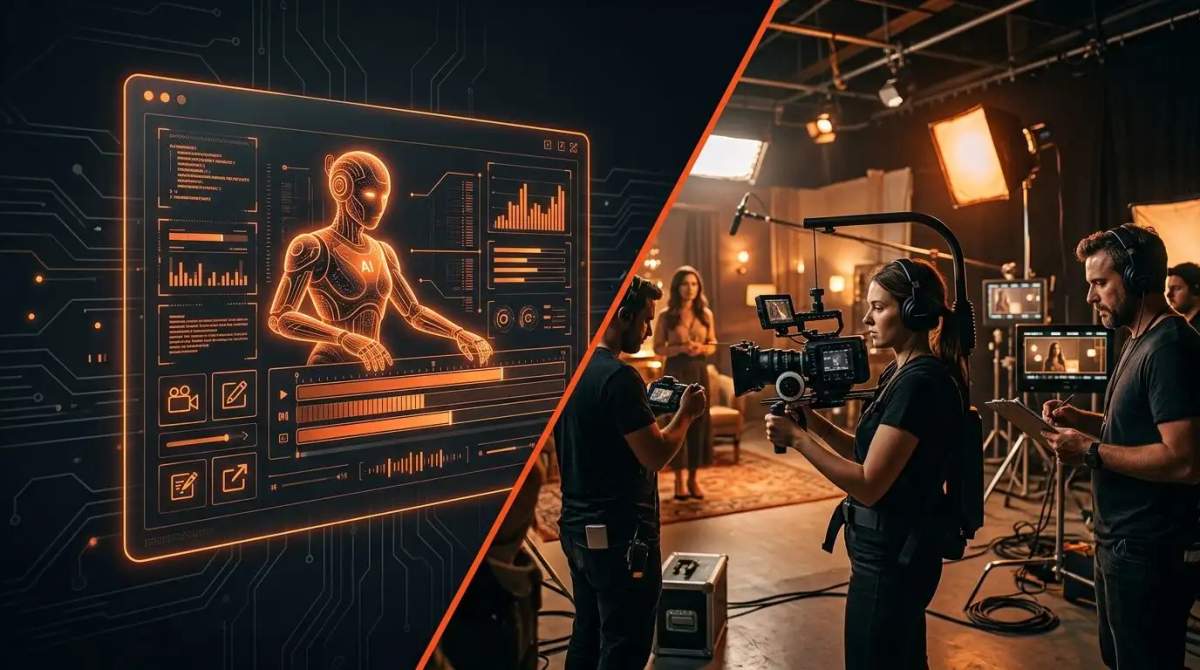
At the same time, AI video production has introduced a different approach. Businesses can now use AI-powered video production workflows to create certain types of professional content faster and with fewer traditional production requirements.
So, which is cheaper?
The answer depends on the type of video you need.
What Does Traditional Video Production Cost?
A traditional video production can involve many different expenses.
A typical production may require:
- Scriptwriting
- Producer and director
- Camera crew
- Lighting equipment
- Audio equipment
- Studio or location
- Actors or presenters
- Makeup and wardrobe
- Travel
- Production assistants
- Video editing
- Motion graphics
- Color correction
- Sound design
A simple talking-head video may require only a small crew and a short shoot. A commercial with multiple locations, actors, special effects, and complex cinematography can require a much larger budget.
The biggest issue isn't always the initial production cost.
It is the cost of making changes.
If a product feature changes after filming, the company may need to schedule another recording session. If a spokesperson makes an important mistake, reshooting may be necessary.
This makes traditional production less flexible for businesses that need frequent updates.
How AI Video Changes the Production Model
An AI video production service can remove or reduce several traditional production requirements.
Instead of bringing a complete film crew to a location, a production workflow can combine AI-generated presenters, AI voices, animation, motion graphics, stock footage, screen recordings, and professional editing.
The result is a different production model.
Traditional production often looks like:
Plan → Shoot → Edit → Review → Publish
AI-powered production can look more like:
Brief → Script → Generate → Edit → Review → Publish
This doesn't mean human creativity disappears. Professional AI video production still requires creative direction, scripting, editing, storytelling, and quality control.
The difference is that AI can reduce some of the repetitive and resource-intensive parts of production.
Where AI Video Can Save Money
Fewer production requirements
For certain projects, there is no need to hire a large camera crew or rent a physical studio.
This can significantly reduce overhead.
Faster production
Traditional filming can take days or weeks when planning, scheduling, shooting, and editing are included.
AI video workflows can shorten production timelines, particularly for simpler content.
Easier revisions
If a script needs to change, an AI-generated video can often be updated without organizing another physical shoot.
This is particularly useful for software companies, educational platforms, and businesses with frequently changing information.
More content from one investment
One of the biggest advantages of AI video production services is scalability.
Instead of spending a large budget producing one video, a brand can potentially create multiple variations for different audiences and platforms.
For example, a product campaign could become:
- A long-form product video
- Three social media videos
- Several short advertisements
- A product tutorial
- An onboarding video
- Multiple language versions
This makes AI particularly attractive to brands using video as an ongoing marketing channel rather than a one-time campaign.
When a Film Crew Is Still the Better Choice
AI video isn't automatically the best solution for every project.
Traditional production remains valuable when authenticity, physical environments, cinematic storytelling, or real human performance are central to the concept.
For example, a luxury brand launching a major campaign may want real locations, professional actors, detailed cinematography, and physical products captured by a skilled camera crew.
Similarly, a documentary, live event, celebrity campaign, or emotionally driven brand film may benefit significantly from traditional production.
The question should therefore not be:
"Should we replace our film crew with AI?"
Instead, ask:
"Which production method gives us the best result for this particular piece of content?"
The Hidden Cost: Time
Budget isn't the only factor brands should consider.
Time has a financial value.
A traditional production may require several meetings, scheduling, location planning, casting, filming, editing, and revisions.
For a company that needs to publish content every week, that process can become a bottleneck.
AI video production can help remove some of those bottlenecks.
This is especially useful for businesses that need large volumes of AI video advertising, social media content, educational videos, or product explainers.
AI Video Is About Scalability, Not Just Lower Cost
The biggest advantage of AI video may not be that every individual video is cheaper.
It is that brands can produce more content without increasing production complexity at the same rate.
Imagine a company wants 50 product videos.
Producing 50 separate traditional shoots would be extremely difficult.
With an AI-powered workflow, the company can establish reusable templates, visual styles, presenters, voices, and editing systems.
This creates a scalable content engine.
Which Option Should Your Brand Choose?
Choose traditional production when your project depends heavily on:
- Real people
- Physical locations
- Cinematic visuals
- Authentic live-action footage
- High-end commercial production
- Complex physical environments
Consider AI video production when you need:
- Faster turnaround
- Frequent updates
- Multiple versions
- Multilingual content
- Social media content at scale
- Product explainers
- Corporate training
- AI avatar videos
- Video advertising variations
For many businesses, the best solution may be a hybrid approach.
Use traditional production for major campaigns and high-value brand films, while using AI video production services for scalable content, tutorials, advertisements, social media, and recurring communications.
The Bottom Line
The real cost of video production isn't simply the price on the invoice.
It includes production time, people, equipment, revisions, scheduling, scalability, and the amount of content you can realistically produce.
Traditional film crews remain essential for many types of high-end video. But AI-powered video production has created a new option for businesses that need professional content quickly and at scale.
For brands producing large amounts of content, the biggest advantage of AI may not be spending less on one video.
It may be getting more useful video content from the same production investment.
That's where an experienced AI video production company can help combine AI technology with professional creative direction, editing, and strategy to create content that is both efficient and effective.
Ready to Scale Your Brand with Custom AI Video Production?
Let ContentMesh build high-performing AI video ads, product showcases, animations, or custom avatars for your brand.